

The risk prevention plan: a document too often forgotten
The risk prevention plan, commonly abbreviated as RPP, is a mandatory document in certain situations, particularly whenever an external company enters a facility to perform work or provide services such as cleaning, window washing, etc.
Traditionally, these plans are managed on paper, which leads to very laborious exchanges between the companies involved. In this day and age, it is essential to use tools that simplify daily operations, while also ensuring greater safety by making risk prevention more effective.
What is a risk prevention plan?
Regulatory definition
The prevention plan is a regulatory document required by the Labor Code (articles R4512-6 to R4512-12). It is mandatory, in particular, when employees from an external company work at a client company's site (such as during construction or service provision). It ensures that:
- The risks associated with co-activity are identified
- The appropriate preventive measures are defined
- The responsibilities of each company are organized
- The safety of all workers is guaranteed
The risk prevention plan is therefore the key tool for formalizing safety between companies and avoiding potentially serious accidents. It should not be viewed merely as a regulatory formality; it is truly the safety roadmap for co-activity.
Objectives of the risk prevention plan
The objectives of the prevention plan are very clear:
- Prevention of accidents and incidents: it allows for anticipating risky situations and implementing necessary actions before accidents occur.
- Ensuring coordination between companies (the client company and the external company): in the event of simultaneous activities, it makes it possible to know who is doing what, where, and how, which helps to avoid dangerous interference between teams.
- Ensure legal compliance: failure to comply with obligations related to the risk prevention plan can lead to administrative and criminal penalties. Maintaining this document is mandatory.
- Improve the company's safety culture: the prevention plan serves as an educational tool to raise team awareness regarding identified risks.
Company obligations
Whether it is the host company (the client) or the contractor (the party performing the work), each has specific responsibilities:
- The host company: must provide all information regarding risks and safety conditions. It must also ensure that the risk prevention plan is created, completed, followed, and must archive the document.
- The contractor: must analyze the risks associated with its activity, communicate them, follow safety instructions, and participate in implementing prevention measures.
Compliance with the obligations of each company is essential to reduce accidents and ensure safety during joint operations. In the event of a breach, penalties may be applied, and consequences can be very severe if serious accidents occur.

The benefits of a digital risk prevention plan
With digitalization, the prevention plan is no longer limited to a piece of paper that can be lost or damaged. Digital transformation now allows you to stop losing your documents and to create them faster, more reliably, and with greater accessibility.
Time savings and simplicity
Creating a risk prevention plan on paper is complicated and time-consuming. Digitalization allows you to:
- Use templates that automatically generate the documents to be filled out.
- Easily send and receive information and signatures.
- To centralize all information relating to coactivity in buildings.
Teams spend less time on paperwork and more time on the operational safety of buildings and employees.
Traceability and compliance
With a digital risk prevention plan, you can maintain a complete history of all actions taken: information updates, modifications, approvals, and signatures. In the event of an audit or inspection, you can very easily retrieve items and justify the measures implemented to ensure safety.
Furthermore, with electronic signatures, you officially and quickly validate documents without delay or loss during transmission.
Reduced risk of errors
Managing a prevention plan on paper is prone to errors: missing information, poor coordination between companies, or lost documents. With a digital risk prevention plan:
- Alerts and reminders prevent oversights
- Mandatory fields ensure that all necessary information is provided
- Real-time, mobile updates ensure you can always identify risks
Errors and oversights are eliminated, providing greater peace of mind for both companies.
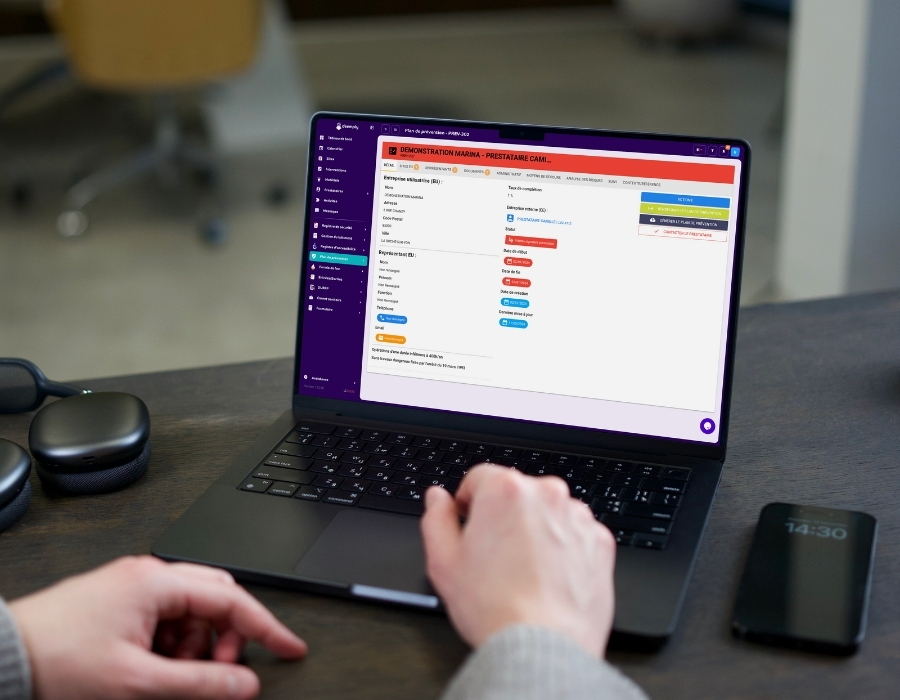
The benefits of the Deemply prevention plan
Key features
The Deemply module is a comprehensive solution for managing your risk prevention plan:
- Automatic document generation: with just a few clicks and using the information you have entered with your service provider, you can download your ready-to-use prevention plan.
- Centralized feedback and validation: each stakeholder fills out and validates the document. You are kept informed at every step via alerts and notifications.
- Secure electronic signatures: no more paper exchanges; signatures are fast and ensure the document's legal validity.
All regulatory obligations in one place
Deemply does more than just manage prevention plans; you can also find:
- Safety register
- Building management
- Hot work permits
- Visitor log
- Health and Safety Log
- Accessibility Register
- Risk Assessment Document
- Form
This interconnection of 9 modules provides you with a comprehensive and consistent view of safety in your buildings.
Operational advantages
The Deemply ecosystem does more than just simplify the management of regulatory obligations. It:
- Reduces the risk of accidents by implementing measures that are better communicated and applied
- Optimizes productivity by significantly reducing time spent on administrative tasks
- Strengthens safety culture by involving all stakeholders in a clear and transparent process
- Facilitates audits and inspections through the tracking and archiving of all information

https://youtu.be/stwySRH8h5A
Conclusion: From compliance to safety performance
The risk prevention plan is much more than a legal obligation: it is a strategic tool for protecting workers and ensuring business continuity in a shared environment. Digitalization, and in particular the Prevention Plan module from Deemply, provides increased efficiency and safety while simplifying regulatory compliance.
By centralizing the creation, validation, and archiving of plans, Deemply allows companies to focus on what really matters: the safety of their employees. The platform transforms an often complex and time-consuming process into a simple, fast, and reliable workflow, adaptable to all structures and sectors.
For all companies, from SMEs to multi-site industrial facilities, digitizing the prevention plan with Deemply is a decisive step toward combining compliance, efficiency, and a safety culture.
Switch to paperless compliance
Safety register, DUERP, health booklet: the Deemply ecosystem centralizes your regulatory obligations and alerts you before deadlines.
.avif)

Good to know
Replace this text with the information you want to highlight.
Bon à savoir
Remplacez ce texte par l’information à mettre en avant.