
Fire safety is often perceived as a burdensome administrative requirement. Yet, at the heart of this process lies a pivotal event: the safety inspection. Whether you are a business owner, a hospital director, or a facility manager, the inspection visit is the ultimate test of your operations.
In this article, we will take an in-depth look at the role of this visit, how it works, and the stakes involved. We will also highlight the tool that can turn the challenge of a safety inspection into a simple formality: the digital safety register.
Understanding the safety inspection
What is a safety inspection?
A safety inspection is an advisory body operating under the authority of the Prefect or the Mayor. Its role is not to penalize you arbitrarily; it is there to verify that regulatory requirements regarding fire and panic risks are met within public access buildings (ERP).
Composition of the commission
To effectively analyze all risks and the entire facility, the safety commission is composed of multidisciplinary experts:
- A representative of the administrative authority (Prefecture or Town Hall).
- A fire prevention officer, whose role is to provide technical advice.
- A representative of the Departmental Directorate of Territories (DDT).
- It is also possible to have police officers or gendarmes present, depending on the context.
Its primary mission
At the end of the visit, the safety commission will issue a favorable or unfavorable opinion regarding the opening or continued operation of the establishment. This opinion is based on the establishment's fire safety management and the observations made on the day of the visit.

For whom is the safety inspection mandatory?
Safety inspections do not apply to all establishments in the same way. It depends on the establishment's classification, which is defined by its type (activity) and category (capacity).
ERP classification
Public-access buildings (ERP) are classified into five categories.
- Categories 1 through 4 include all establishments with the highest occupancy levels. Periodic inspections are mandatory for these. The frequency depends on the type of activity (cinemas, hospitals, hotels, etc.) and may occur every 2, 3, or 5 years.
- The 5th category, which covers smaller establishments, does not require systematic inspections. The safety commission primarily visits before the establishment opens and upon request if there are concerns regarding safety.
Key moments for safety commission inspections
Safety commission inspections fall into 3 main categories:
- Before opening: This is when the establishment receives authorization to open to the public. This is known as the commissioning inspection.
- Periodically: As noted, the purpose of this visit is to ensure that building and system maintenance has not been neglected.
- After renovations: This allows for the validation of structural changes to the premises and ensures that these modifications remain compatible with public access.

How does a commission inspection work?
A safety inspection is not something to be improvised. It follows a protocol divided into three major phases.
Phase 1: Administrative review
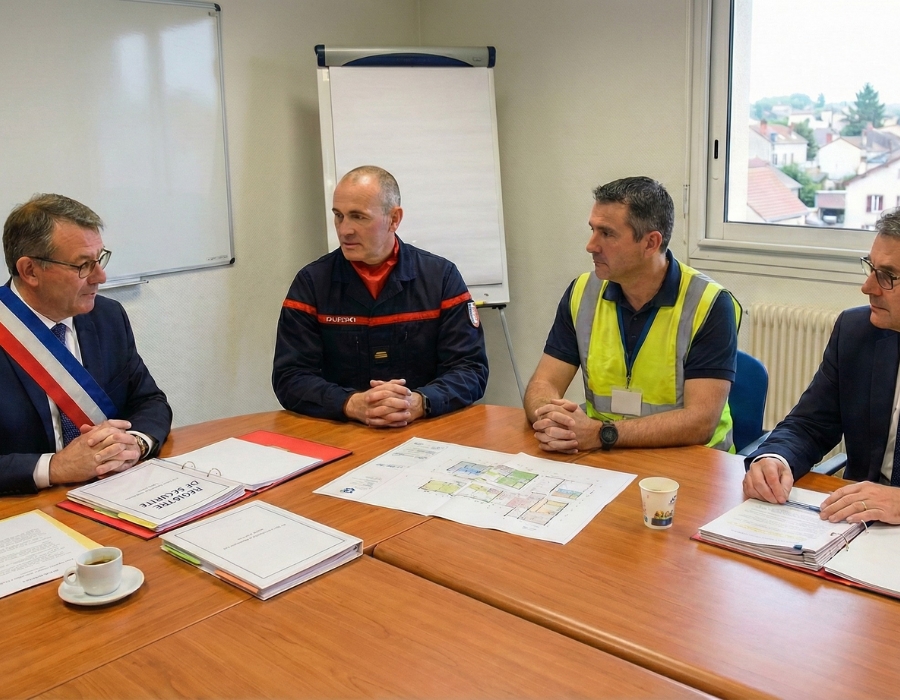
This is where experts will examine your company's safety records: the fire safety register. The commission will set up in a room you have prepared and review the document in detail. They verify various elements, such as:
- Technical inspection reports for electricity, gas, elevators, alarm systems, etc.
- Staff training certificates (fire safety, first aid, etc.).
- Minutes from previous inspections and the resolution of any requirements that were previously issued.
Phase 2: On-site assessment
The safety commission tours the establishment. They will not check everything, but will target critical points such as:
- Smoke extraction: Actual tests of hatch openings may be performed.
- The compartmentalization: Fire doors will be checked to ensure they work properly.
- Evacuation: Emergency exits will be checked to ensure they are clear. Emergency lighting (BAES) will also be inspected.
- Fire extinguishing equipment: The commission will, for example, verify access to the fire hose reels (RIA) and the placement of fire extinguishers.
Phase 3: Deliberation and verdict
After the inspection, the safety commission deliberates and issues its opinion. There are three possible outcomes:
- Favorable opinion: Operations continue as normal.
- Favorable opinion with reservations: You may remain open, but you must address specific issues within a set timeframe.
- Unfavorable opinion: This is the worst-case scenario.
The impact of an unfavorable opinion and potential sanctions
An unfavorable opinion serves as a warning for your establishment. The Mayor may then decide to issue an administrative closure order. This means your business will have to close until the necessary steps are taken to obtain a favorable opinion from the safety commission.
An unfavorable opinion may also have repercussions:
- Civil liability: In the event of a fire following an unfavorable opinion, your insurance may refuse to cover the damages.
- Criminal liability: The manager can be held personally liable for "endangering the lives of others." Fines of tens of thousands of euros can be imposed, along with prison sentences in the event of an incident.
The importance of the safety register during a commission inspection
The safety register is not just a red folder gathering dust in a cupboard; it is the cornerstone of your establishment's fire safety.
A tool for evidence
When a fire safety inspector arrives, they don't necessarily know you. Their first impression is formed by how the register is maintained. A register that is scribbled in, incomplete, or out of date immediately suggests poor safety management, which prompts the commission to be much more rigorous during the physical inspection.
What the register must demonstrate
The safety register must prove that you have adhered to the required inspection schedule. For example, if you do not have an electrical inspection report that is less than a year old, the safety commission may note an "absence of inspection." This is a very common reason for an unfavorable opinion.
As a reminder, the register must centralize:
- The dates of inspections and the technicians' observations.
- Compliance or maintenance work carried out.
- Previous safety inspection reports.
- The inventory of emergency equipment.

The benefits of a digital safety register
In 2026, digital tools are no longer optional in our daily lives. The same applies to fire safety. The classic paper binder has become a real handicap for day-to-day safety management.
Centralization and accessibility of information
Choosing a paper register means risking it being lost or locked away in an inaccessible office. If this happens, you face an uncomfortable situation that could prove very costly. By choosing a digital register, you can access your data anywhere and on any device: computer, tablet, or smartphone.
For safety commission experts, this accessibility of information is a sign of transparency and modernity.
Automatic alerts and notifications
Automation and alerts are among the major benefits of digitalization. With Deemply, you can set which notifications you want to receive and how often. You are also automatically notified about your inspections, with alerts indicating when a check is due. You are also kept informed throughout the inspection process: completion of the work, signing off, report submission, creation of observations, and resolution of those observations.
Traceability and resolution of non-compliance
Digital tools allow you to link your reports to corrective actions. You can thus prove, with photos if necessary, that the issue has been resolved.
This management style reassures the safety commission, as they can see that your facility is well-maintained and that recommendations are being addressed.
Discover the digital safety register
Conclusion
The safety commission should be viewed as a partner rather than an adversary. They ensure that, in the event of a disaster, human lives are protected and your liability is covered. However, this peace of mind is only achieved through rigorous organization of your fire safety.
This is why a digital safety register is no longer just a convenience; it is now a strategic shield. It will simplify your life and enhance your brand image with the authorities by demonstrating your flawless compliance.
Switch to paperless compliance
Safety register, DUERP, health booklet: the Deemply ecosystem centralizes your regulatory obligations and alerts you before deadlines.
.avif)

Good to know
Replace this text with the information you want to highlight.
Bon à savoir
Remplacez ce texte par l’information à mettre en avant.