As a public-access establishment, also known as an ERP, you may sometimes find it difficult to understand your establishment type and category. Without this vital information, it can be challenging to fulfill your regulatory obligations. To help you understand your ERP type, we invite you to read this article.

The different ERP categories
As a reminder, regulations define an ERP as any establishment, building, premises, or enclosure that receives members of the public. This includes, for example, amusement parks, shops, and schools. Access to the premises can be provided in any way, whether paid, free, by invitation, or restricted.
Under fire safety regulations, the different types of ERPs are classified into categories.
These 5 categories group establishments according to their capacity. To determine your category, you must calculate your capacity, including your employees, unless you fall into category 5.
Here are the capacity details by ERP type:
- If your establishment can accommodate more than 1,500 people, it falls into category 1.
- Category 2 establishments have a capacity between 701 and 1,500 people.
- Those with a capacity between 301 and 700 visitors fall into category 3.
- Category 4 covers establishments that accommodate a maximum of 300 people.
- Category 5 is defined by the number of people the establishment can accommodate as well as the type of activity. The nature of the inspections also plays a role in classifying an establishment as 4th or 5th category.
In all cases, categories are defined by regulation; if in doubt, it is essential to refer to the regulations and consult an expert when necessary.
The different types of ERP activities
The capacity of your public-access establishment is not the only factor you need to consider. The type of activity your ERP conducts is also essential to know in order to comply with your regulatory obligations and safety commission inspections.
ERPs are classified into 30 types of establishments divided into two categories: those located in a building and special establishments.
Establishments located in a building are categorized as follows:
- J: Residential care facilities for the elderly and people with disabilities.
- L: Auditoriums, conference halls, meeting rooms, performance venues, or multi-purpose halls.
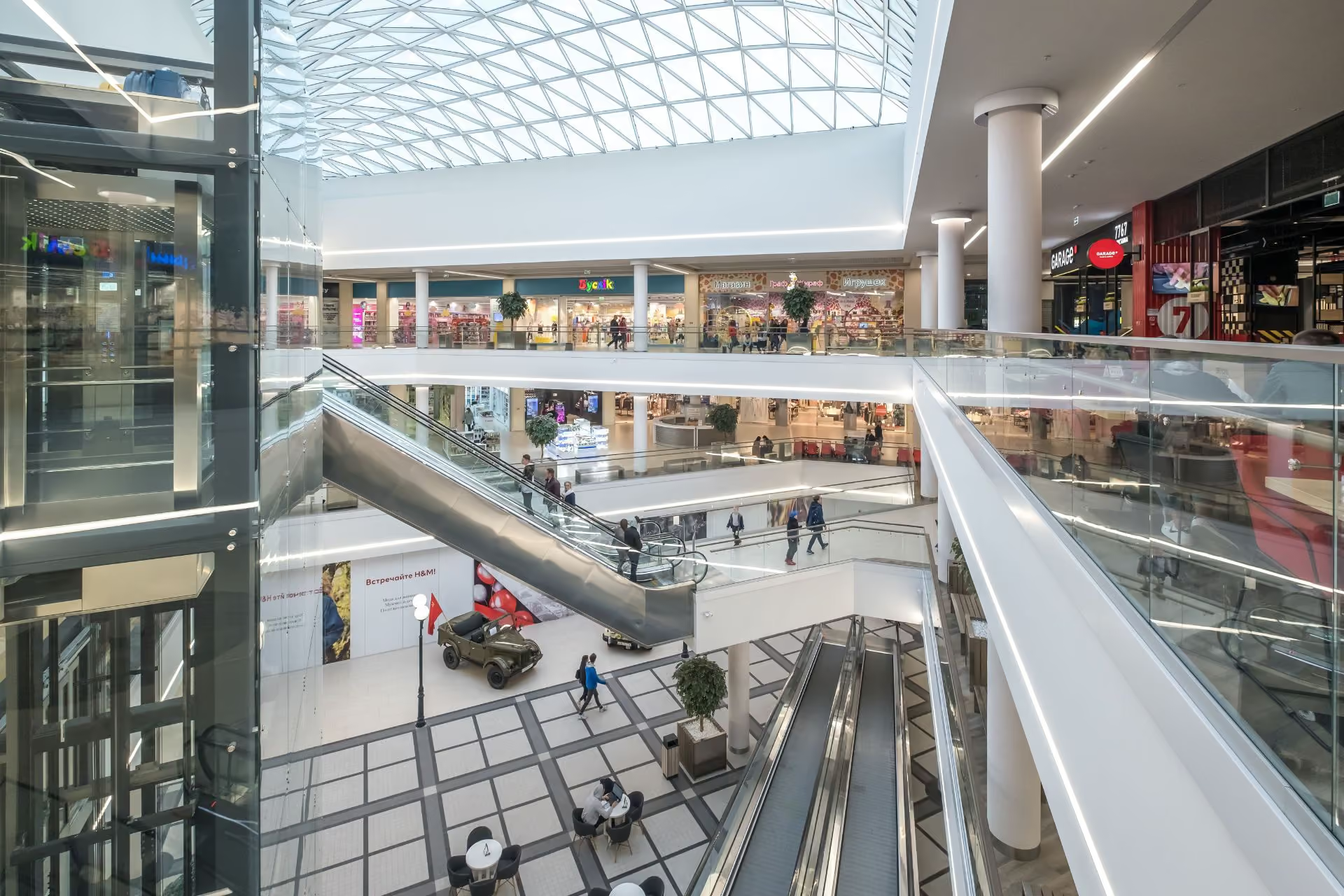
- M: Retail stores and shopping centers.
- N: Restaurants and bars.
- O: Hotels and boarding houses.
- P: Dance halls and game rooms.
- R: Educational and training facilities, daycare centers, holiday camps, and non-residential leisure centers.
- S: Libraries and documentation centers.
- T: Exhibition halls.
- U: Healthcare facilities.
- V: Places of worship.
- W: Administrative offices, banks, and office buildings.
- X: Indoor sports facilities.
- Y: Museums.
Special establishments include:
- PA: Open-air establishments.
- CTS: Marquees, tents, and temporary structures.
- SG: Inflatable structures.
- PS: Covered parking garages.
- GA: Railway stations.
- OA: High-altitude hotels and restaurants.
- EF: Floating establishments.
- REF: Mountain huts.
Combining your ERP type with its category will allow you to determine the frequency of your safety commission inspections.
Safety commission frequency by ERP type
Safety commission inspections must be carried out every three or five years, depending on the establishment's type and category.
Types J, L, M, N, O, P, R (with and without accommodation), S, T, U, W, X, and Y in the first and second categories must undergo safety commission inspections every 3 years.
Those in types J, L, O, P, R (with and without accommodation), and U in the third category are also subject to this schedule. The three-year frequency also applies to 4th category establishments of types J, O, R (with accommodation), and U.
Safety commission inspections every 5 years apply to all type V categories. This frequency also applies to 3rd category establishments of types M, N, S, T, W, X, and Y, as well as those in the 4th category of types L, M, N, P, R (without accommodation), S, T, W, X, and Y.
As you can see, your ERP type is defined by various criteria. To help identify your category, you can refer to the latest report issued by the safety commission or seek guidance from an expert who can advise you on your regulatory obligations based on your ERP type.
Watch our video to see how Deemply simplifies your daily routine
In our demonstrations, you will be able to discover all the features of our Deemply ecosystem.
Switch to paperless compliance
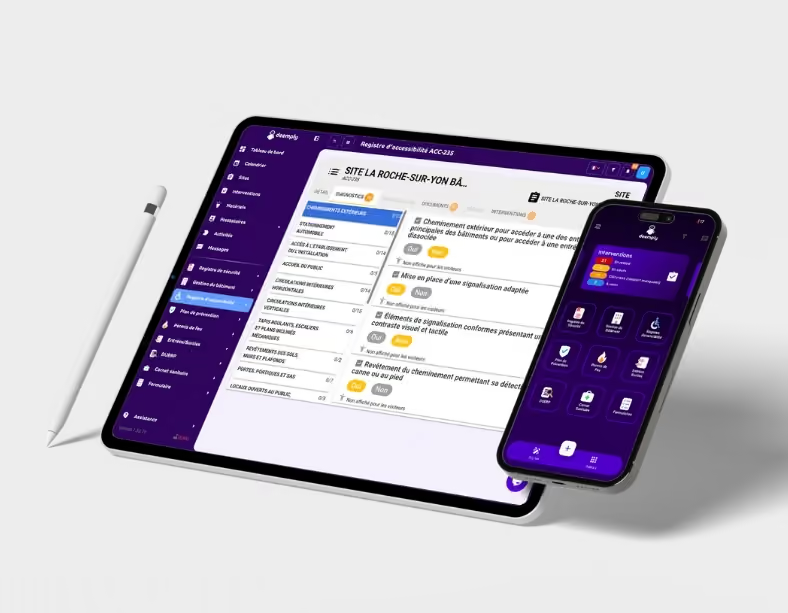
Safety register, DUERP, health booklet: the Deemply ecosystem centralizes your regulatory obligations and alerts you before deadlines.
.avif)

Good to know
Replace this text with the information you want to highlight.
Bon à savoir
Remplacez ce texte par l’information à mettre en avant.