Public-access buildings (ERP) are subject to regulations regarding safety and fire prevention. Regardless of the establishment's category or type, the fire safety register consolidates the legal obligations of site operators.
Classification of public-access buildings for fire safety and prevention
The Construction and Housing Code (CCH) subjects Public-Access Buildings (ERP) to fire safety and prevention obligations. In this context, ERPs are defined as “all buildings, premises, and enclosures in which people are admitted, either freely, for a fee, or through any form of participation, or in which meetings are held that are open to anyone, whether by invitation or not, and whether paid or free” (art. R123-2 of the Construction and Housing Code).
To cover the diversity implied by this definition, ERPs are classified to determine the regulations applicable to each one.

Each ERP is therefore subject to both general provisions and specific requirements based on:
- Its “type”, which refers to the establishment's activity and the nature of the building's operation (art. GN1 of the Fire and Panic Safety Regulations for public-access buildings (ERP) approved by the decree of June 25, 1980):
– The 22 types of establishments designated by a letter.
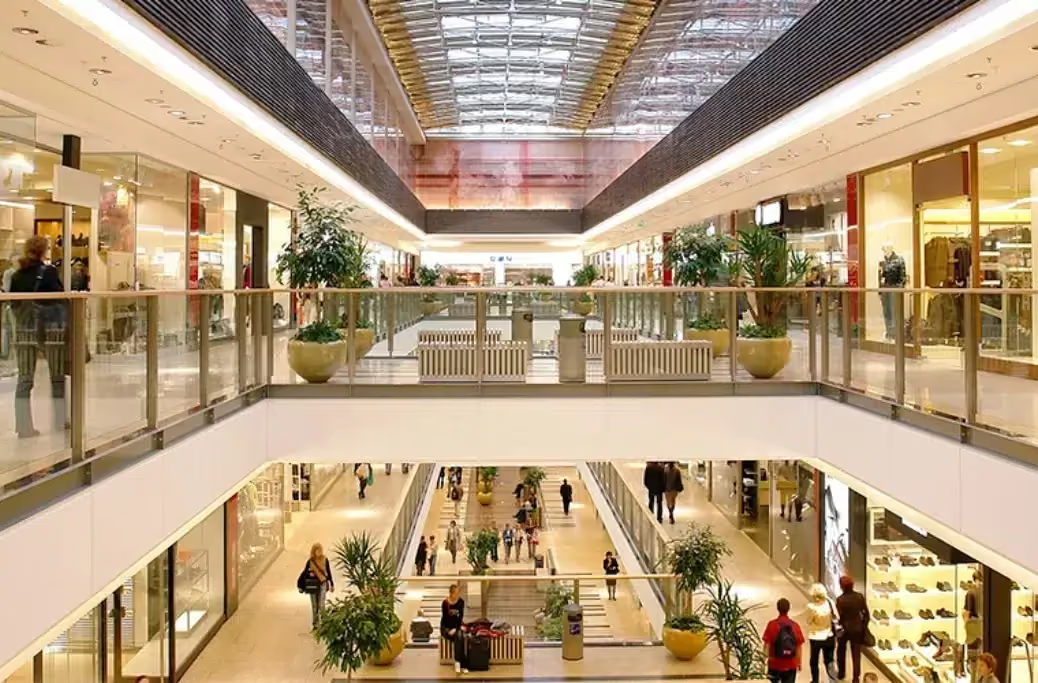
– Establishments located in a building: J (care facilities for the elderly and people with disabilities), L (auditoriums, conference halls, etc.), M (shops, shopping centers), etc.
– Special establishments: PA (outdoor facilities), CTS (marquees, tents, and structures), SG (inflatable structures), PS (covered parking garages), etc.
- Its “category”, which refers to the establishment's capacity, taking into account both the public and staff present in areas accessible to the public (art. R123-19 of the CCH):
– 1st category: over 1,500 people
– 2nd category: 701 to 1,500 people
– 3rd category: 301 to 700 people
– 4th category: 300 people or fewer, excluding 5th category establishments
– 5th category: capacity below the threshold set by the safety regulations for the specific establishment (art. 123.14 of the CCH).
Safety commissions for inspecting public-access buildings
The safety commissions are tasked with monitoring compliance with fire safety and accessibility standards for public-access buildings (ERP). Several commissions exist, depending on the category and type of the facility:
- Departmental Advisory Commission for Safety and Accessibility (CCDSA), chaired by the prefect at the departmental level.
- Municipal safety commission, chaired by the mayor and under the aegis of the CCDSA.
Safety commissions conduct inspection visits at every stage of a public-access building's lifecycle:
- Acceptance inspection upon completion of construction, prior to the building's opening.
- Acceptance inspection prior to the reopening of a facility that has been closed for more than 10 months.
- Acceptance inspection in the context of construction or renovation work.
- Periodic inspection visits based on the facility's category and type of operation.
- Unannounced inspections, following reports or at the request of the mayor or prefect.
During these visits, they mobilize a representative of the prefect or sub-prefect, the mayor or a municipal councilor, a firefighter, an agent from the DDT (Departmental Directorate of Territories), and a police or gendarmerie officer, and require the presence of the facility operator.

The safety register: A legal requirement
Public-access buildings are legally required to maintain a safety register (art. R143-44 of the CCH). Also known as a fire safety register, this document is central to safety and fire prevention. It involves the criminal liability of the operator, the owner, and/or the builder, as well as the RUS (Single Safety Manager), where applicable.
The content of the safety register for public-access buildings specifically lists technical inspections of site installations and equipment, staff training, renovation work, as well as official reports and documents related to these items. Serving as both a tracking tool and a reference document, the safety register must be available for presentation at any time by the facility manager or the RUS to safety commissions or any other authority.
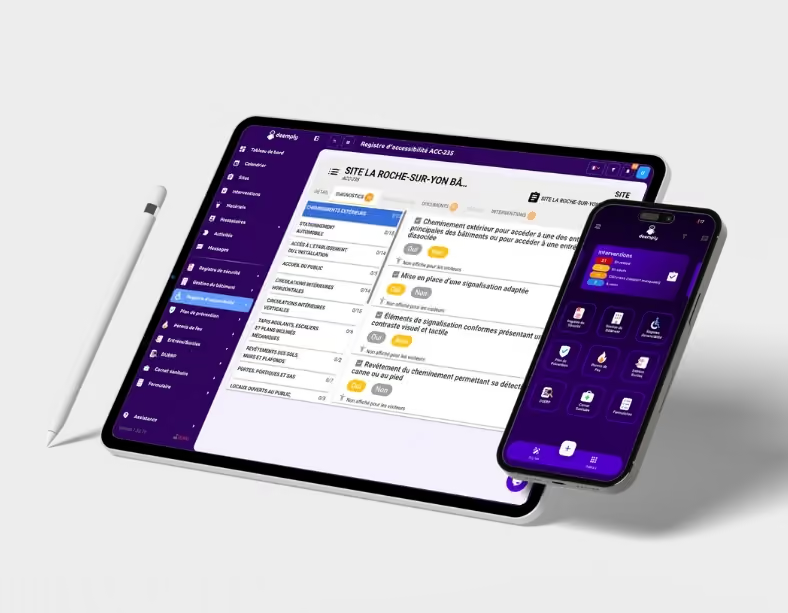
Choosing a digital safety register now allows for the optimization of safety and fire risk management for any public-access building, thanks to the following features:
- Tracking of controls and technical inspections.
- Preparation and anticipation for safety commission visits.
- Management of staff safety training.
Our tool Deemply is suitable for all types and categories of public-access buildings. Regardless of the nature of your facility, we invite you to discover our online safety register to better manage risks on your site.
Watch our video to see how Deemply simplifies your daily routine
Switch to paperless compliance
Safety register, DUERP, health booklet: the Deemply ecosystem centralizes your regulatory obligations and alerts you before deadlines.
.avif)

Good to know
Replace this text with the information you want to highlight.
Bon à savoir
Remplacez ce texte par l’information à mettre en avant.